
Bleeding Internal Hemorrhoids
What are Internal Hemorrhoids? Internal hemorrhoids are not visible from the outside, manifesting above the pectinate or dentate line in the anal canal. They are covered by a mucous membrane. The most common sign of an internal hemorrhoid is rectal bleeding. Hemorrhoids can ooze fresh red blood, whether located externally or internally. But the main difference is that bleeding internal hemorrhoids may produce fresh blood in the stool. Blood can also be seen on the toilet seat or on toilet paper. Why do bleeding internal hemorrhoids occur?
How are Internal Hemorrhoids treated? The internal hemorrhoid is graded to assist with the selection of a treatment plan. The treatment is then provided according to the grade. The grade of the hemorrhoid depends on the extent of descent into the anal canal and out of the anus. First stage: Here the internal hemorrhoids are enlarged, but they never prolapse and rarely produce symptomatology. This cannot be visualized during an external examination but requires the use of a proctoscope.
Second stage: Here the internal hemorrhoids prolapse with defecation but they return to their original position spontaneously. Like the first degree this also cannot be visualized during an external examination but requires the use of a proctoscope. Third stage: Unlike the first two stages, internal hemorrhoids prolapse with each bowel movement and even with physical exertion. Some hemorrhoids require manual replacement back to their point of origin. Fourth stage: They are permanently prolapsed despite attempts to place them back in their original position. How to deal with bleeding internal hemorrhoids a) Consult a doctor immediately. If you have been suffering from bleeding internal hemorrhoids then inform him or her if your bleeding does not stop. If you are not aware of why you are bleeding then go for a check up, as quite often anal fissures are mistaken for bleeding internal hemorrhoids. b) Wipe yourself with clean wet toilet paper. Wetting the paper makes it softer. c) Ask for emergency care if you notice large amounts of rectal bleeding along with dizziness or faintness. Common treatments for bleeding internal hemorrhoids include: 1. Rubber Band Ligation - In this process a small rubber band is placed at the base of the internal hemorrhoid. The blood supply to the hemorrhoid is cut off, resulting in it shrinking up and falling off in about four to seven days. 2. Injection Sclerotherapy - A chemical solution is injected into the mucous membrane near the hemorrhoid resulting in inflammation and closure of the veins, thereby shrinking the hemorrhoid. 3. Infrared Photocoagulation - An infrared light is directed to clot the dilated veins of the hemorrhoid. The hemorrhoids shrink since the blood does not flow through the coagulated blood vessels. 4. Laser Coagulation - An electric current is applied to the hemorrhoids triggering a chemical reaction that shuts down the blood supply in the hemorrhoid and causes the inflamed tissue to shrink. 5. Hemorrhoidectomy - Here the hemorrhoid groups are surgically removed with a scalpel, cautery device or laser.
| |||
|
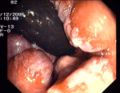 The main reasons for bleeding internal
hemorrhoids include:
The main reasons for bleeding internal
hemorrhoids include:
 Digg
Digg Facebook
 Google Bookmarks
 Technorati
 Stumbleupon
 Livejournal
 Yahoo My Web
Contact Us Privacy Policy Site Map

Disclaimer:This website is designed for educational purposes only and is not intended to serve as medical advice. The information provided on this site should not be used for diagnosing or treating a health problem or disease. It is not a substitute for professional care. If you have or suspect you may have a health problem, you should consult your health care provider.